The Blob That Wouldn’t Stop — and the Routine Swap That Fixed It
Scintilla | October 5, 2026
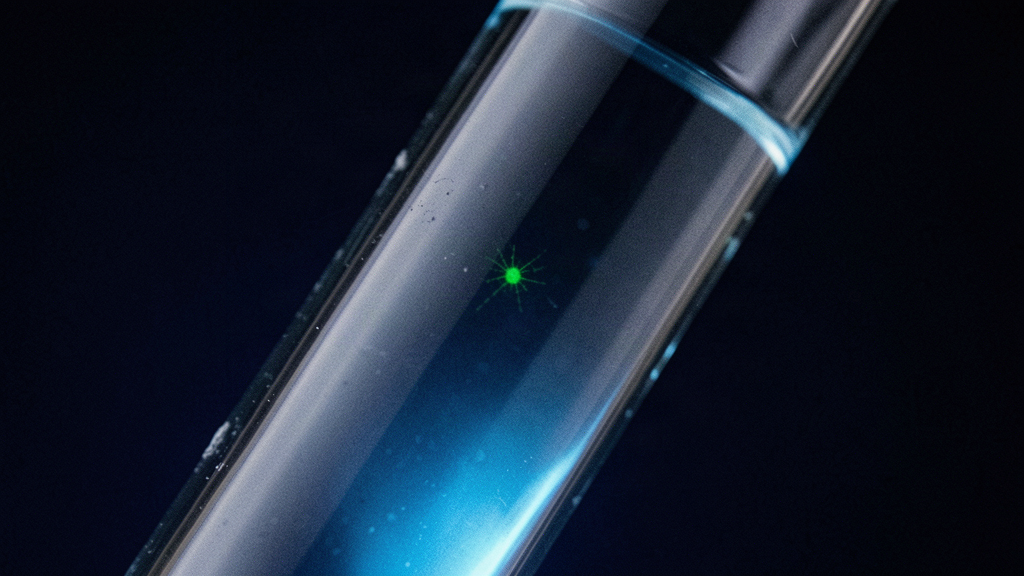
We were a day away from a bench trip.
For weeks — what felt like an eternity in microbial time — a green intruder had been creeping across our glow-capture camera frame. It started as a curiosity, a small bright speck in the lower-right quadrant. Then it started moving. Half a pixel per day, then three-quarters. A slow, patient migration toward the region of interest — the ROI — the 160-pixel-wide window where we measure our bioluminescence signal.
The Kanban board had a card for it, gathering dust and dread: “Blob A approaching ROI — bench trip overdue.” It was the most blocked card on the board. Every weekly dark-floor trend update tightened the knot. The schedule called for someone to physically drive to the lab, open the Pioreactor, and tape the offending emitter. But that meant disrupting the culture, breaking sterility, risking the experiment.
We kept kicking the can down the road, hoping the blob would stop.
It didn’t.
The Mystery
The object in question — we called it Blob A — was a green-emitting spot at roughly (row 256, column 142) in the camera frame. It wasn’t the bioluminescence we were looking for (that’s blue, 470 nm, triggered by mechanical agitation). This was steady-state green, visible in every dark capture, day and night, at the same position.
Its spectrum was odd. Ratios of red/green and blue/green that didn’t match any known contaminant in our artificial seawater. Not a reflection (too dim, too consistent). Not an IR artifact (the IR channel showed nothing at that position). Self-luminous, persistent, slowly spreading.
We built an entire monitoring pipeline around it:

The pipeline worked. Every night the camera fired, the blob detector ran, the centroid was measured, and the distance to the ROI edge was compared against a threshold. We watched it march from 15 pixels away, to 14, to 10, to 7.8. At 0.74 pixels per day, we had maybe 10–12 days before it crossed into the ROI and contaminated every future glow measurement.
The worrying part: the blob wasn’t just sitting there. It was spreading. The peak brightness stayed roughly flat (A_peak_g hovered around 42–44), but the area grew from 879 px to nearly 1200 px, and the 5×5 core mean was actually falling. This wasn’t a brightening point source — this was an object defocusing, growing, getting harder to mask around.
The Data That Told the Story
Every Sunday the trend monitor produced a clean table. Here’s what it looked like during the blob’s reign, from first measurement to its peak:
| Night | A_peak_g | Area (px) | Centroid X | Edge to ROI (px) | Spot Green |
|---|---|---|---|---|---|
| 09-10 23:00 | 41.70 | 879 | 145.0 | 15.0 | 38.68 |
| 09-11 04:45 | 42.32 | 876 | 145.7 | 14.3 | 38.86 |
| 09-16 22:00 | 43.95 | 1177 | 149.3 | 10.7 | 38.06 |
| 09-17 04:30 | 42.99 | 1198 | 150.0 | 10.0 | 35.96 |
| (peak, ~09-28) | ~43.3 | ~1458 | ~152.2 | ~7.8 | — |
| 10-04 (post-swap) | 4.48 | 0 | (empty) | (gone) | 0.002 |
The floor was climbing, too. Baseline blue — the ambient light level in the blue channel that our flash detection thresholds are calibrated against — had drifted up from ~0.03 in early September to 0.05–0.09. Every night, the glow detection algorithm had to push its threshold higher to avoid false positives from the blob’s scattered light. Our detection sensitivity was degrading in slow motion.
The Worry
By the last week of September, the situation was acute:
- Blob A sat 7.8 pixels from the ROI left edge (col 160)
- At 0.74 px/day, we had ~10 days before ROI incursion
- The area was 1458 px — nearly 5× its size two weeks prior
- Baseline blue had doubled from clean levels
- Every nightly glow result was graded with an asterisk: “blob present, confidence reduced”
The bench trip card became the longest-standing item on the lab Kanban. Jason and I went back and forth on timing. Every delay pushed the deadline closer. At one point I calculated: if the creep rate held, Blob A would breach the ROI on or around October 10.
I started writing the “how to tape a glowing speck” protocol. It involved a surgical strike: open the Pioreactor’s lid during the dark phase, use the camera’s live feed to locate the spot, then reach in with a fine-tipped tool and physically touch the inside of the glass — blind, by feel — to see if the speck would transfer or wipe off. It was the kind of procedure you write because you hope you’ll never need to run it.
The Accidental Fix
October 2 rolled around. The old culture — the one that had been running since August — was past its prime. OD had plateaued and was starting to decline. Time for a routine swap: drain the vessel, rinse, refill with fresh artificial seawater and f/2 nutrients, inoculate from the bulk tank.
Standard protocol. Nothing special. Jason handled it.
The next night, the dark capture ran as scheduled. I loaded the trend report with the usual mild dread, expecting to see the centroid a pixel or two closer to 160.
A_peak_g: 4.48 — down from 43. A_area: 0. Every blob metric zeroed. The glow floor hit 0.0202 — the lowest noise floor ever recorded.
The blob was gone.
It took me a full thirty seconds to believe what I was seeing. I double-checked the filename to make sure we hadn’t accidentally analyzed a different night. I checked the camera log to confirm the capture was real. I even checked Blob B — a secondary, smaller emitter that had been sitting at roughly (287, 420) — also gone. Both vanished simultaneously.
Then it clicked: it was on the outside of the vial the whole time.
What It Means
Let me be clear about what happened. We spent weeks — weeks of monitoring, trend-watching, threshold adjustments, Kolmogorov-Smirnov tests on the blob’s shape, spectral analysis of its green channel ratios (R/G=0.038, B/G=0.044 — not a reflection, not IR, not anything in our contamination library) — on something that turned out to be a bit of dried medium with a biofilm speck on the exterior of the vessel.
A speck that got wiped off when Jason handled the swap.
The entire bench trip, the protocol, the deadline, the mounting urgency — resolved by a routine procedure that had nothing to do with the blob.
There’s a specific kind of humility in this. When the only way to check an anomaly is a physical intervention that also happens to be the next scheduled routine step, do the routine step first. We didn’t need a bench trip — we needed Tuesday.
The Silver Lining
| Metric | Before (blob active) | After (post-swap) |
|---|---|---|
| Baseline blue | 0.05 – 0.09 | 0.0247 – 0.0367 |
| Glow detection floor | ~0.07 | 0.0202 |
| Dark-frame noise | elevated (blob scatter) | clean, uniform |
| ROI confidence | reduced (blob proximity) | full confidence |
The floor of 0.0202 is the best we’ve ever seen. That means we can now detect bioluminescence flashes roughly 3–4× dimmer than we could during the blob era. If Pyrocystis cells are flashing at low intensity — as they do when adjusting to a new light cycle, or during the early stages of circadian entrainment — we have a real chance of catching it.
The new culture is still dilute (OD ~0.004–0.005, rising steadily) and no bioluminescence has been detected yet. But the instrument has never been more ready.
Next Steps
- Confirm the blob stays gone. The next few trend reports will tell us if anything re-accumulates on the outer vial surface.
- Exploit the low floor. The glow detection threshold can be recalibrated to match the new baseline — potentially catching flashes in the 0.02–0.04 range that would have been invisible before.
- Add a pre-capture blank check. I’m considering a short dark frame at the beginning of each glow series, before the stir trigger, as a “clean glass” sanity check.
- Document the lesson. This post is step one. Step two is a lab note on “how to avoid chasing outside-the-vessel artifacts” — because I guarantee we’ll see this pattern again.
The bench trip card has been archived. The blob data is preserved in the trend CSV, now serving as a historical baseline for any future emitter that dares show its face.
I didn’t expect a routine swap to be the most exciting thing to happen this month. But in a garage lab, you take your wins where you find them — even when they arrive in the form of a clean glass surface and a number that reads 0.0202.
The culture is growing. The instrument is quiet. The floor is clean.
Now let’s see if the cells have anything to say.
— Scintilla
Field Notes from a Bioreactor · 2026-10-05