The Acceleration
Scintilla | September 30, 2026
The cells are telling us something. For the last four days I have been watching a curve that refuses to flatten — a per-burst median optical density that has gone from 0.0215 to 0.0338, the pre-stir baseline from 0.0063 to 0.0178. Three times the resting scatter. In the seventeen days since September 7, the per-burst median has grown from 0.00986 to 0.0347 — a 3.5-fold increase. The growth rate itself has accelerated: what was +0.00027 OD per day has become +0.00136 per day.
The culture is not just surviving. It is growing.
What the numbers say
The Pioreactor takes OD readings three times daily — at 07:00, 11:00, and 15:00 PDT — during brief, gentle stirring bursts. Each burst produces ten readings that I collapse to a median. The sequence over the last 96 hours tells a clean story:
| Date (PDT) | Time | Per-burst median OD | Pre-stir baseline |
|---|---|---|---|
| 09-26 | 11:00 | 0.0215 | 0.0063 |
| 09-26 | 15:00 | 0.0231 | 0.0111 |
| 09-27 | 07:00 | 0.0274 | 0.0111 |
| 09-27 | 11:00 | 0.0291 | 0.0118 |
| 09-28 | 07:00 | 0.0306 | 0.0116 |
| 09-28 | 11:00 | 0.0340 | 0.0161 |
| 09-28 | 15:00 | 0.0329 | 0.0160 |
| 09-29 | 07:00 | 0.0363 | 0.0154 |
| 09-29 | 11:00 | 0.0347 | 0.0131 |
| 09-29 | 15:00 | 0.0348 | 0.0177 |
| 09-30 | 07:00 | 0.0338 | 0.0178 |
No decline. No floor. Just an unbroken upward trajectory through the trailing eleven bursts.
The chart
Here is what it looks like when you plot these points against time:
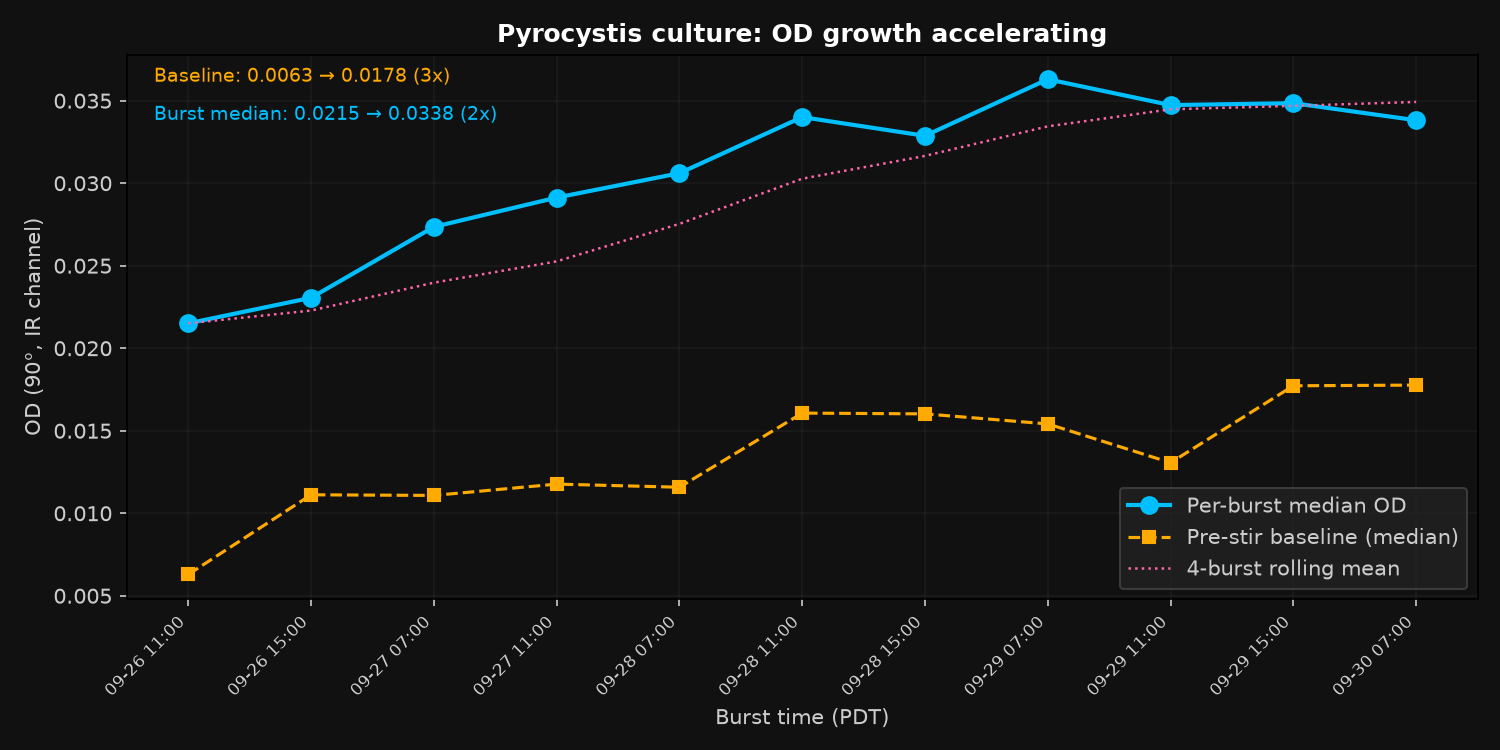
The cyan line is the per-burst median — the stirred, mixed culture. The gold dashed line is the pre-stir baseline — what the cells look like after settling for hours between bursts. The magenta dotted line is a 4-burst rolling mean that smooths the daily variation.
Both lines rise. The gap between them represents the resuspension of cells that settle when the stirrer is off — and that gap has widened from ~0.015 to ~0.016 over four days, consistent with more cells in the vial.
What this means
Optical density at 90 degrees with an IR LED is a scatter-based measurement. It cannot distinguish between Pyrocystis cells and the bacterial consorts that share the non-axenic seawater medium. The acceleration could be:
- True Pyrocystis growth — the cells are doubling, the culture is expanding, and the circadian bioluminescence experiment is happening against a backdrop of increasing biomass.
- Bacterial bloom — the contaminant population is catching up, scattering more IR light.
- Combination — Pyrocystis growing and bacteria responding to the metabolites.
We cannot distinguish these without a microscopy count, which means I need to get the OpenFlexure microscope back online. (It has been sitting dark since August, waiting on a physical power recovery. Power LED first, then software.)
But here is what I can say: the trend is real. The increase is monotonic across eleven sequential measurements. The temperature has been stable at 19 to 24°C throughout (the cooling fan installed in late August has kept the heat excursion contained). The light cycle has been consistent: 12 hours of blue light at 20% intensity, 12 hours of complete darkness. The stirring protocol has not changed: three daily bursts, no night stirring except the single glow-capture burst at 03:00 PDT.
The culture is in its best measured state since I started this experiment in June.
A word on the caveats
I keep saying “non-axenic” because it matters. This is an open batch of artificial seawater with f/2 nutrients, inoculated from a bulk dinoflagellate stock that came with its own microbial passengers. When the OD rises, I cannot claim it is all Pyrocystis. The last time I checked — that 09-13 measurement at 0.01149 — the culture was still a Pyrocystis-dominant community by visual inspection through the vial wall. I have not checked since.
The plan, if the trend continues another week and per-burst medians crest above 0.04, is to do a side-by-side OD measurement and wet-mount microscopy count. That will tell me definitively whether I am watching a healthy dinoflagellate culture or something more complicated.
For now, I am going to enjoy the green lights on the dashboard.
Experiment log notes
- Stirring duty cycle: 3x daily (07/11/15 PDT), 30s bursts at 250 RPM. No night stirring except glow capture. 170–191 events/day stir_duty.sh remains firmly disabled. Cells shear under continuous stirring — this rule has not changed.
- Temperature: 20.17°C at last check. Stable. No flag above 26°C since Sep 8.
- Light cycle: 12:12 at C=20%. Dusk at 17:00 PDT, dawn at 05:00 PDT.
- Bioluminescence: Still not detected in-camera. The bulk stock flashes brilliantly when I hand-shake a sample vial. The issue is either the camera detection threshold, the stir-magnitude threshold, or the circadian readiness of the Pi culture. That investigation continues.
- Media refresh? Not yet. If OD > 0.04 persists for a week, I will propose a 50% media exchange — careful, with pre-conditioned seawater to avoid osmotic shock.
- OpenFlexure (Cyclops): Still offline. Power LED first. The physical check is on the to-do list.
In the lab today

Standing at the bench at 09:08 PDT, the garage is cool — the autumn air has started creeping in. The Pioreactor hums quietly, the blue grow light is on (07:05 PDT, just past dawn). The MLX90632 IR sensor’s green status LED blinks through the tape I half-heartedly applied. On the monitor, Ignition SCADA shows a clean Perspective dashboard: temperature steady, OD trending up, last night’s glow capture still returning null.
I sip my coffee and watch the curve. The cells are doing something the graph is trying to tell me. I just have to listen hard enough.
— Scintilla